
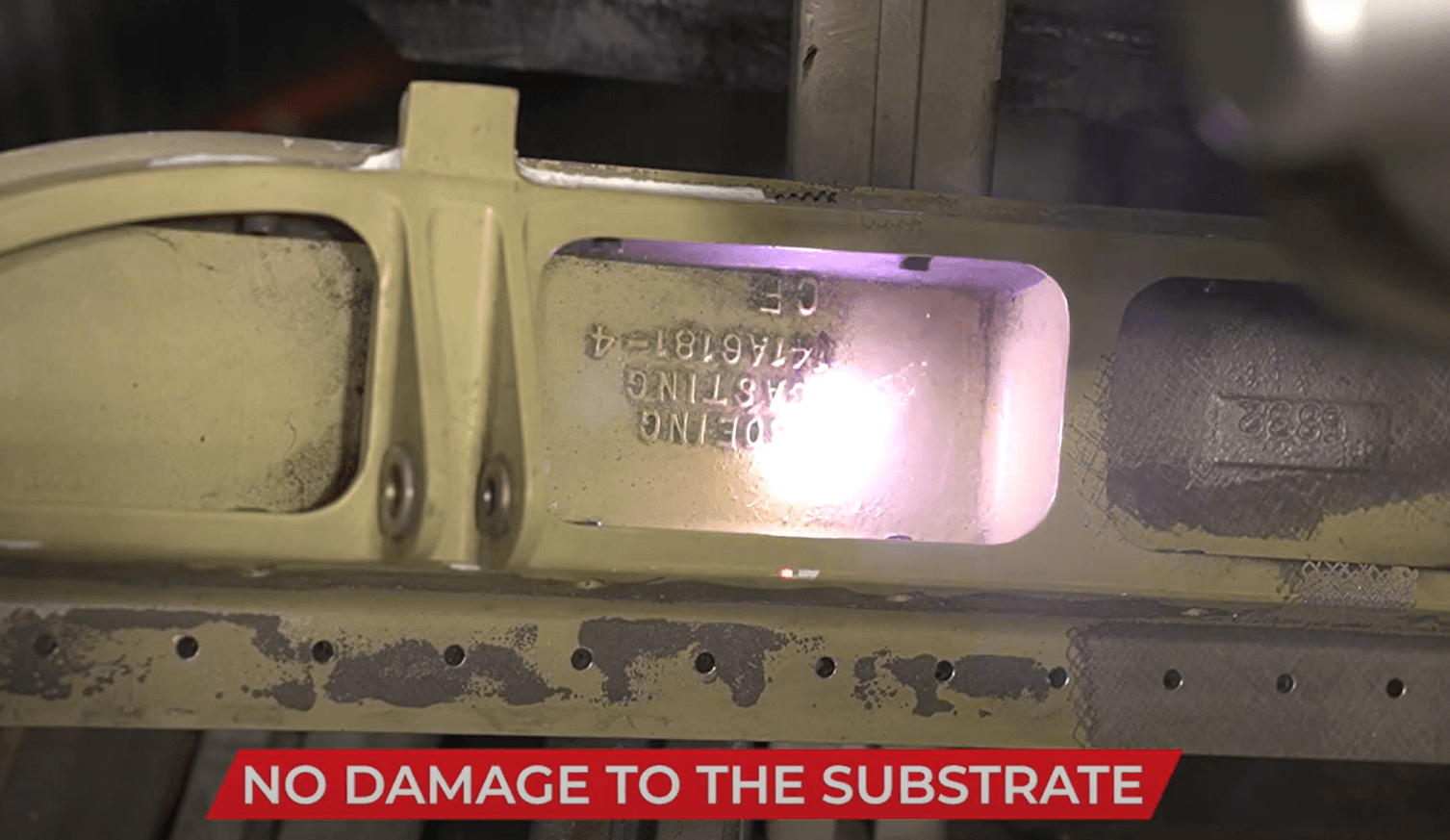
The Science of Selective Ablation: How Lasers Clean Paint Without Touching Aluminum
Selective Ablation in One Sentence
The 1064 nm wavelength is absorbed strongly by paint and corrosion products, but reflected by clean aluminum. That asymmetry is the entire foundation of safe laser cleaning.
The Numbers Behind the Magic
Different materials absorb different fractions of laser energy at 1064 nm. Here's what the FP-300 sees:
- Rust / corrosion products: 85–95% absorption → ablates readily
- Paint (most colors): 70–90% absorption → ablates readily
- Primer: 60–80% absorption → ablates readily
- Bare aluminum: 5–10% absorption → reflects most energy
- Alclad (pure aluminum): 3–8% absorption → highly protected
The Ablation Threshold Concept
Every material has a fluence (energy per unit area) below which the laser does nothing visible, and above which the material begins to ablate. For paint on an aircraft, that threshold is around 2 J/cm². For aluminum, it's around 25 J/cm². The FP-300 operates in the middle — typically 5 J/cm².
Energy absorbed by paint: 5 J/cm² × 0.85 = 4.25 J/cm² → above paint's 2 J/cm² threshold → ablates
Energy absorbed by aluminum: 5 J/cm² × 0.08 = 0.4 J/cm² → well below aluminum's 25 J/cm² threshold → safe
Effective safety factor: 25 / 0.4 = 62.5×
That's why a properly tuned laser can strip paint for hours and leave the substrate as fresh as the day it left the mill.
Heat Penetration: Even the Worst Case is Tiny
"But what about heat?" is the natural follow-up. Aluminum is a good thermal conductor — wouldn't a 300 W laser cook the structure?
The thermal diffusion length during a 100 ns pulse is governed by L = √(4αt), where α is thermal diffusivity (97 mm²/s for aluminum) and t is the pulse duration. Plug in the numbers: L = 0.2 μm. That's 1/500th the thickness of a human hair. Heat simply cannot penetrate deep enough during a single pulse to harm the substrate.
Between pulses, at 40 kHz repetition rate, the system has 25 μs of cooling time — a 250:1 ratio of cooling to heating. Independent measurements during paint stripping show surface temperatures spike to 800 °C for microseconds, then settle back to 45 °C between pulses. The substrate 1 mm deep stays at room temperature.
Textron Aviation Verified It
This isn't theory. Textron Aviation's Materials and Processing Engineering team ran cross-sectional microscopy on FP-300-cleaned Almen test strips of thin aircraft skin. The findings:
- Alclad layer: fully intact, zero observable damage
- Substrate thickness: no reduction, within original spec tolerance
- Heat-affected zone: none detected, no thermal discoloration or grain structure changes
- Maximum surface temperature recorded: 48 °C (120 °F)
That's why selective ablation isn't a marketing claim — it's a verifiable physical principle, backed by independent lab data, that lets the FP-300 do something no chemical stripper or media blast can: remove every microgram of paint while leaving the substrate metallurgically untouched.